
- Published
- Author
- Name
- @thefireguyspdx
Commercial Kitchen Safety with UL 300-Compliant Fire Suppression
A fire suppression system is designed to extinguish, control, or prevent the spread of fire with specific chemical compounds.
It's been almost 30 years since UL 300 redefined the rules for commercial kitchens to account for health-conscious chefs cooking with vegetable oils in place of animal fat and the introduction of state-of-the-art cooking equipment. New deep fryers, for instance, now come equipped with excellent heat retention and insulation features, resulting in a more efficient cooking experience. Unfortunately, these factors also increase fire hazards in cooking areas.
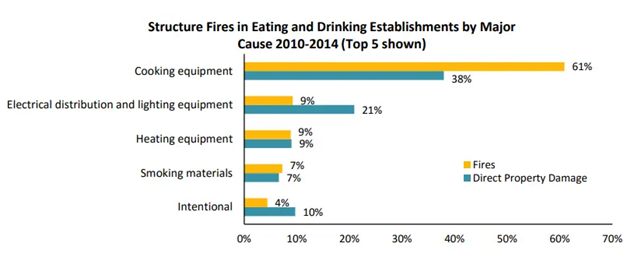
NFPA statistics show that for eating and drinking establishments, the majority of fires occur in the kitchen and specifically involve cooking equipment.
These factors are why UL recognized the need for a new set of standards and developed UL 300 when the shift from lard to vegetable oils was taking place.
This also necessitated an upgrade to a more modern system that meets the UL standards to ensure proper suppression of vegetable oil fires.
But despite the advancements in fire protection technology required by the UL 300 standards, many restaurants have yet to fully protect their business by upgrading to a modern kitchen fire suppression system.
Why Upgrade?
Switching from animal fat to vegetable oil can weaken a suppression system because vegetable oils burn at higher temperatures, are more susceptible to ignition, and are more difficult to extinguish than animal fats. Also, the dry chemical suppression systems used in commercial kitchens are not effective in suppressing hotter fires.
One important requirement of UL 300 is that deep fryers use wet chemical fire suppression systems. Like dry chemical systems, wet chemicals can effectively smother and put out the fire, but they serve a second purpose that dry chemicals can't accomplish; cool the oil so it doesn't reignite. This is of utmost importance when putting out a vegetable oil fire since these oils have an auto-ignition temperature of 685 degrees F or hotter (compared to 550 to 600 degrees F for lard), which is only further enhanced by high-efficiency, heat-retaining fryers.
What are the requirements for a UL-300 system?
Fire-suppression systems that are UL 300-compliant must use a wet-chemical agent. Wet chemicals suppress flammable vapors but also cool the source so it can't reignite.
In addition to using a wet-chemical agent, UL-300 systems must also include:
- A manual pull station
- An automatic fire detection system
- Automatic fuel shut offs for gas and electric
- Nozzles located in the hood and duct
- Nozzles located over each grease-generating cooking appliance
- Wet-chemical system serviced semi-annually by an authorized licensed service company
Remember that although a system may be labelled as a 'wet chemical', that doesn't necessarily mean it is UL-300 compliant. You can find if your product is UL listed at UL Solutions.
In addition to installing appliances and kitchen features that meet the UL 300 standard, you must also take certain measures to remain up to code.
- Have the wet chemical fire suppression system serviced twice a year by a licensed fire protection company like Metro Safety & Fire.
- Have the hood and ductwork maintained and cleaned twice a year by a licensed service company.
- Clean the baffle filter weekly or as recommended based on the type of cooking you conduct.
If I Have A UL 300 Fire Suppression System - Why Do I Need a Class K Fire Extinguisher?
Because the installed fire suppression system is designed to handle the main fire; detecting the fire and shutting off the heat source at the hood, the K Class fire extinguisher adds a vital component in fire protection in and around areas that may require fire defense such as microwaves, stoves or flash fires involving oil or fat.
According to NFPA 10, Standard on Fire Extinguishers, a Class K portable fire extinguisher is defined as an extinguisher that is designed to extinguish fires involving animal fats or cooking oils. The extinguishers discharge a chemical that reacts with the cooking oil or fat to produce a soapy media that sits on top of the fuel and smothers the fire. The chemical process of creating this soap involves the reaction of the acidic (low pH level) extinguisher discharge with the basic (high pH level) cooking oil or grease and is called “saponification.”
How is Class K different than Class B extinguishers?
Class B extinguishers are meant to be used against fires involving flammable liquids. The big difference is the type and depth of the flammable substance and whether it be a liquid (oil) or a solid (animal fat). Another difference is the speed at which the extinguishing agent is dispelled from the cylinder. Since Class K extinguishers are trying not to penetrate the top layer of fuel, the extinguishing agent is often dispensed at a lower pressure to not disturb the fuel and to prevent it from spreading.
If you use a fire extinguisher on a fire involving animal fats or cooking oils that are not rated for Class K fires, it can result in a much bigger fire or even an explosion.
Always use the appropriate fire extinguisher according to code. Find out the requirements for the coverage needed at NFPA LiNK 2022 NFPA-10.
Sources: