
- Published
- November 10, 2026
- Author
- Name
- @thefireguyspdx
#Devices That Connect to the Fire Control Panel Have Specific Requirements That May Surprise You
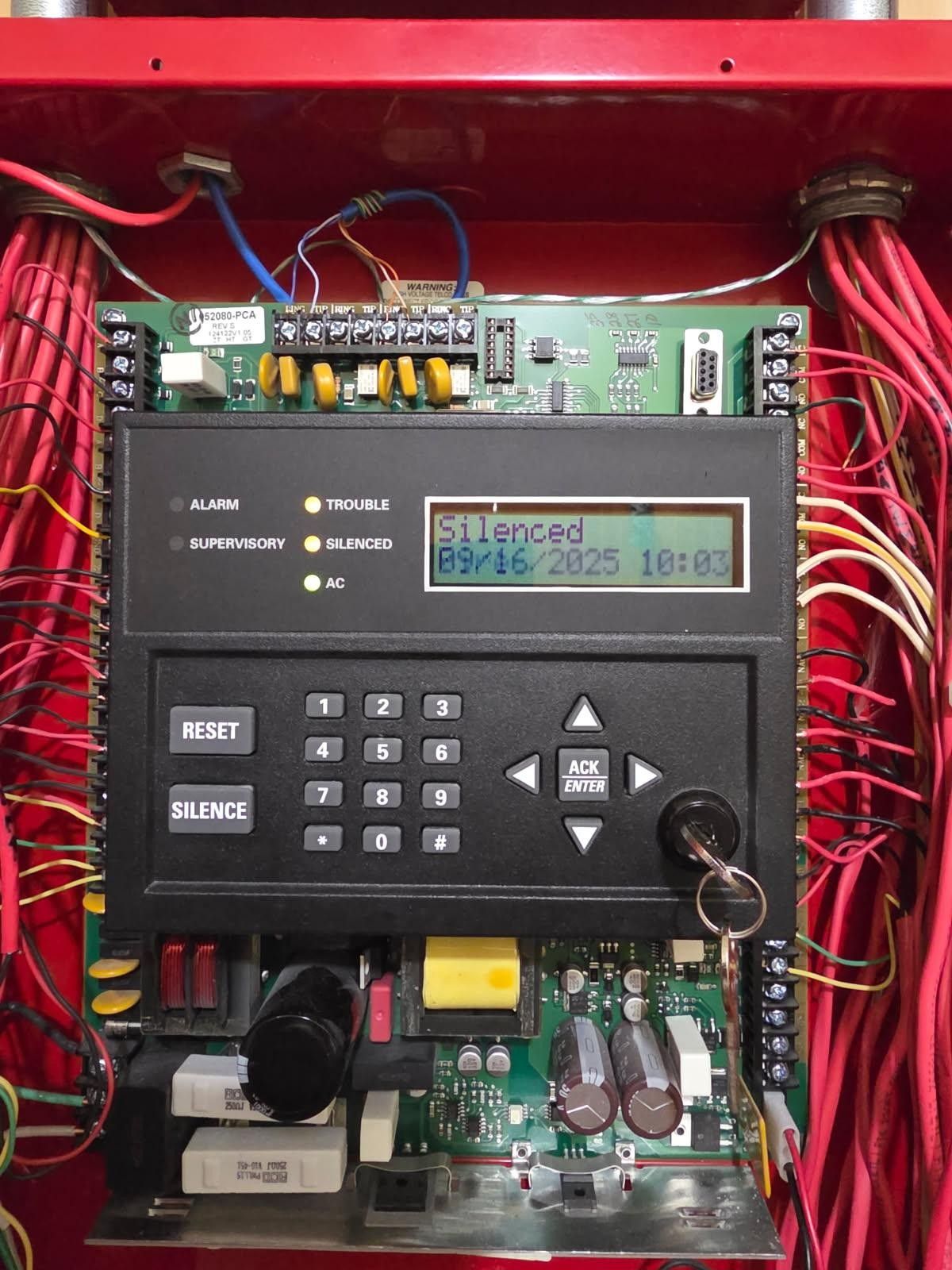
The Fire Alarm Control Panel (FACP) is the decision-making center of the fire alarm system: it receives input, determines the condition, and controls the appropriate response.
Alarm Initiating Devices - heat & duct detectors, manual pull stations and water flow switches; Notification Appliances - horns & strobes and Supervisory Signal-Initiating Devices - tampers and air pressure switches are typical devices connected to the FACP.
And just that simply, your business is covered – but wait, behind these devices are strategic requirements you may have never thought of before.
#Ceiling layout matters
Smooth ceilings, beams, joists, sloped ceilings, high ceilings, and obstructions can change detector spacing.
Smoke and Heat detectors: Spot-type smoke/heat detectors are generally installed on the ceiling. If sidewall-mounted, they have different mounting requirements.
Beams can create separate pockets: Deep or widely spaced beams may require detectors in individual beam pockets or reduced spacing; the ceiling should not automatically be treated as smooth.
#Placement matters
Pull stations are required to be conspicuous, unobstructed, and accessible - not hidden behind doors, displays, furniture, or equipment, and they must be within 5 ft of each exit doorway on each floor adding pull stations for every 200 (horizontal) feet. And Grouped openings wider than 40 ft; pull stations are required on both sides and within 5 ft of each side of the opening.
#Sound matters
In sleeping areas, the sound of the alarm is measured from the pillow and must be the loudest of these three options:
- 75 dBA (roughly the volume of a busy roadside or a coffee grinder).
- 15 dB above the average background noise.
- 5 dB above the maximum background noise if it lasts for at least 60 seconds.
For extremely noisy spaces visual alarms (strobes) are mandatory if the average background noise ever goes above 105 dBA (about the loudness of a chainsaw).
#Brightness matters
Strobes are generally 110-177 cd eff. For context - 1 candela (cd) is traditionally based on the brightness of a single candle, however, Effective Candela (cd eff) calculates how bright a flashing light appears to the human eye, accounting for the fact that quick bursts of light don't look as bright as a continuous beam.
Strobes in corridors, where more than two visual appliances are in any field of view, are also required to flash in synchronization.
#Timing matters
When a sprinkler is activated because of heat, water begins flowing through the sprinkler piping. The flowing water moves a vane or paddle-type switch or Waterflow Switch. The alarm must activate within 90 seconds when the flow is equivalent to the flow from one sprinkler with the smallest orifice installed in the system.
A Tamper switch monitors the position of a sprinkler system control valve. If the valve begins moving away from its normal, fully open position, the switch changes state and sends a supervisory signal to the fire alarm control unit - not a fire alarm signal.
Air-pressure switch monitors the pressurized air or nitrogen in a dry-pipe or preaction sprinkler system. It uses pressure-set contacts to detect an abnormal pressure condition and transmit a supervisory signal.
#Not every room or area is treated the same
Notification coverage depends on whether a space is occupiable and who the signal is intended to serve. A closet may not require audibility, while a similarly sized file room may.
The standard does not require the emergency evacuation signal to automatically operate in exit stair enclosures or exit passageways. The primary purpose of the fire alarm notification appliances is to alert occupants while they are in occupied spaces and direct them toward the exits. Once people enter a protected exit stair enclosure, additional horns and strobes are generally not needed to tell them to evacuate—the stair is already the egress route.
#Beyond the obvious
When triggered, the FACP may
- Recall elevators to a designated floor – to avoid occupants from getting trapped in shafts filled with smoke
- Shut down or control fans – avoiding the spread of toxic smoke
- Operate smoke dampers – to isolate the fire zone and contain smoke in a specific compartment
- Release doors held open – allowing them to self-close and form a barrier that may delay the spread of fire
- Unlock doors – releases electromagnetic locks on secure stairwells, exits, and access-controlled doors to prevent people from being trapped while escaping
- Release shutters - drops fire-rated rolling shutters in large openings, counter spaces, or atrium areas to maintain the building's fire-rated barriers
- Activate exit-marking devices - illuminates or triggers specialized path-marking systems to guide occupants through low-visibility environments
#How It All Works
NFPA 72 describes these as emergency control functions - actions initiated by the fire alarm system to improve occupant life safety or control the spread of fire and dangerous products.
The typical sequence is:
- Initiating device activates, for example, smoke detection or sprinkler waterflow.
- Fire alarm control unit processes the signal.
- Alarm signals are transmitted to a supervising station, fire station, or responsible government agency, where prescribed response action can be taken.
NFPA 72 also requires alarm notification appliances, emergency voice communications, emergency control interfaces, and protected-premises annunciation to operate within 10 seconds after an initiating device activates.
#Supervisory vs Trouble
NFPA 72 defines a trouble condition as “an abnormal condition in a system due to a fault.”
Generally meaning there is a fault in the fire alarm or signaling system itself - the system, wiring, power supply, or component is impaired.
Common examples include:
- Open circuit in an initiating-device, notification-appliance, or signaling circuit
- Ground fault on a supervised circuit
- Broken or disconnected wiring to a device
- Disconnected sprinkler supervisory circuit wiring - for example, an open fault in the wiring to a valve switch.
- Loss of or disconnected backup battery
- Low battery condition. NFPA 72 identifies battery removal, disconnection, or low battery as conditions that produce a distinctive trouble signal.
- Open or ground fault on an auxiliary circuit connected to a municipal master box
- An interconnection fault that prevents connected initiating devices or notification appliances from operating normally
A supervisory condition is different: it concerns an abnormal condition in another system or equipment being supervised by the fire alarm system.
Examples of conditions that can appear as supervisory on a fire alarm panel include:
- A sprinkler control valve changes position - for example, a normally open valve is closed.
- Low air pressure on a dry-pipe sprinkler system
- Low or high pressure outside the required range
- Low liquid-agent level, such as inadequate foam concentrate
- Low temperature in a protected room or valve room
- Loss of power to an electric fire pump
- A fire pump running
- Fire-pump phase reversal.
- An engine-driven pump controller left in the “off” or nonautomatic position.
- Fire-pump conditions such as low oil, high engine temperature, or overspeed.
- Low water-tank level or temperature.
- Low steam pressure or an abnormal steam control-valve position for a steam-turbine pump.
#Practical rule
Supervisory = the monitored fire-protection equipment is not in its normal state.
Trouble = the fire alarm system has a fault or cannot properly perform its function.
In some cases, both can occur - for example, a fault in one system can impair a function being supervised by another system. Neither indication should normally be treated as a fire alarm, but both should be investigated and corrected promptly.
#When You Need It Done Right
Metro Safety & Fire, Inc. has been your neighborhood fire inspection company for over 40 years. Let us take the guess work out of protecting your business.
We are Focused on Service, Driven to Excellence, Committed to Educate
Call us today to set up your business location for service and let Metro Safety & Fire, Inc. take the guess work out of protecting your greatest assets.